Manager Mode
Dream11 has 200M+ users, and all of them play fantasy sports one match at a time. Manager Mode was our attempt at something longer: a tournament-spanning format where you manage a team across an entire IPL season.
00
problem
Traditional fantasy formats create sharp, short-term engagement spikes. Users build a team, compete for a match, and reset. This leads to inconsistent retention, repetitive decision loops, and limited room for long-term strategy. We needed a format that encouraged sustained play, meaningful ownership, and a sense of progression across an entire tournament.
solution
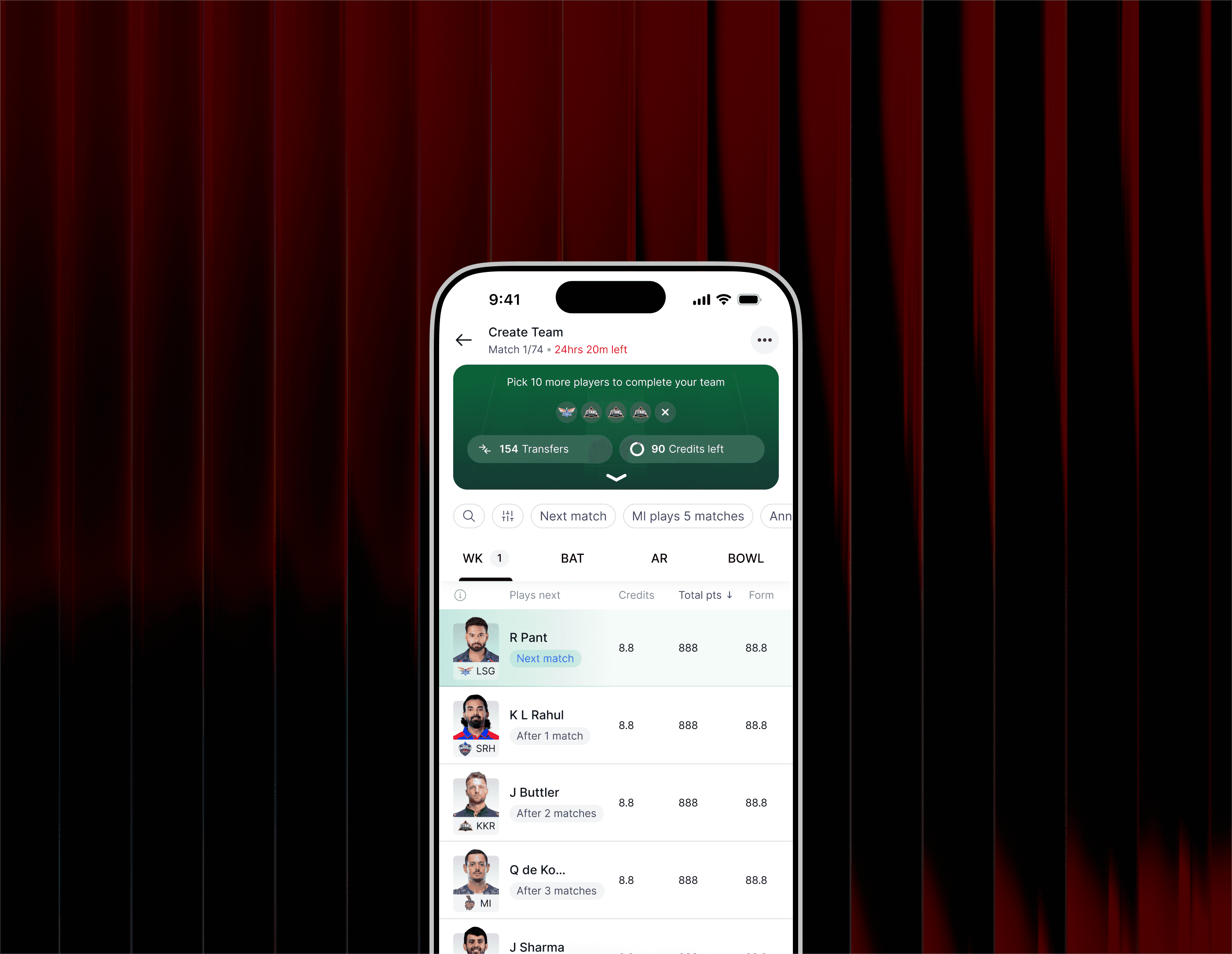
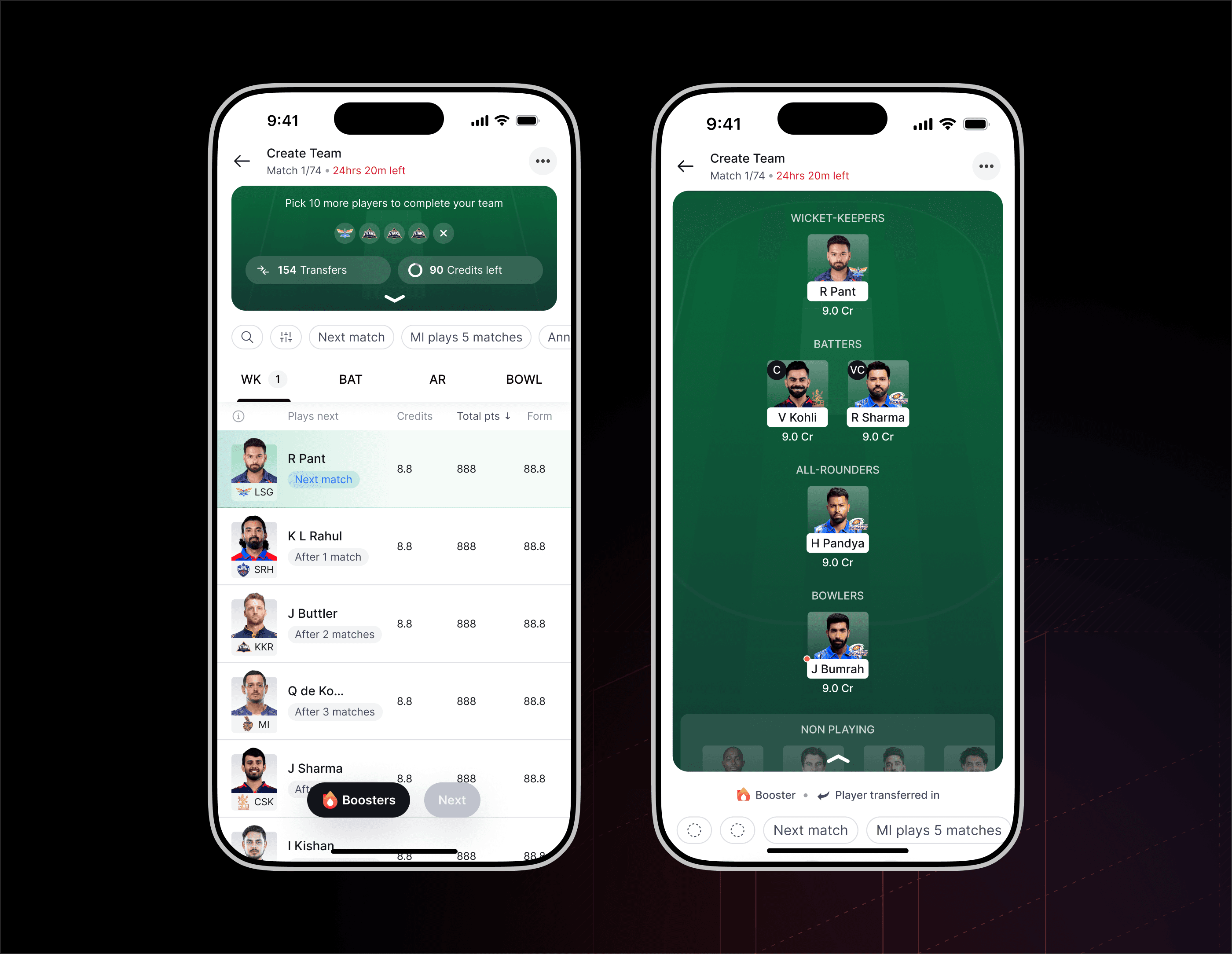
Manager Mode introduced a season-long structure with transfers, boosters, squad building, and role-based constraints. Users manage a 11-player squad, optimize week by week, and plan around fixtures, form, and availability. The design centered on transparency, minimal cognitive load, and clear weekly rhythms, allowing casual users to participate confidently while giving advanced users the strategic depth they expect.
Manager Mode reimagines how fans play fantasy cricket. Instead of match-to-match picks, it gives users a long-arc game where every decision compounds over a season. My work focused on shaping the structure, pacing, and clarity needed for a high-engagement format at scale.
I. Two Problems, One Product
1. Engagement collapsed mid-tournament:
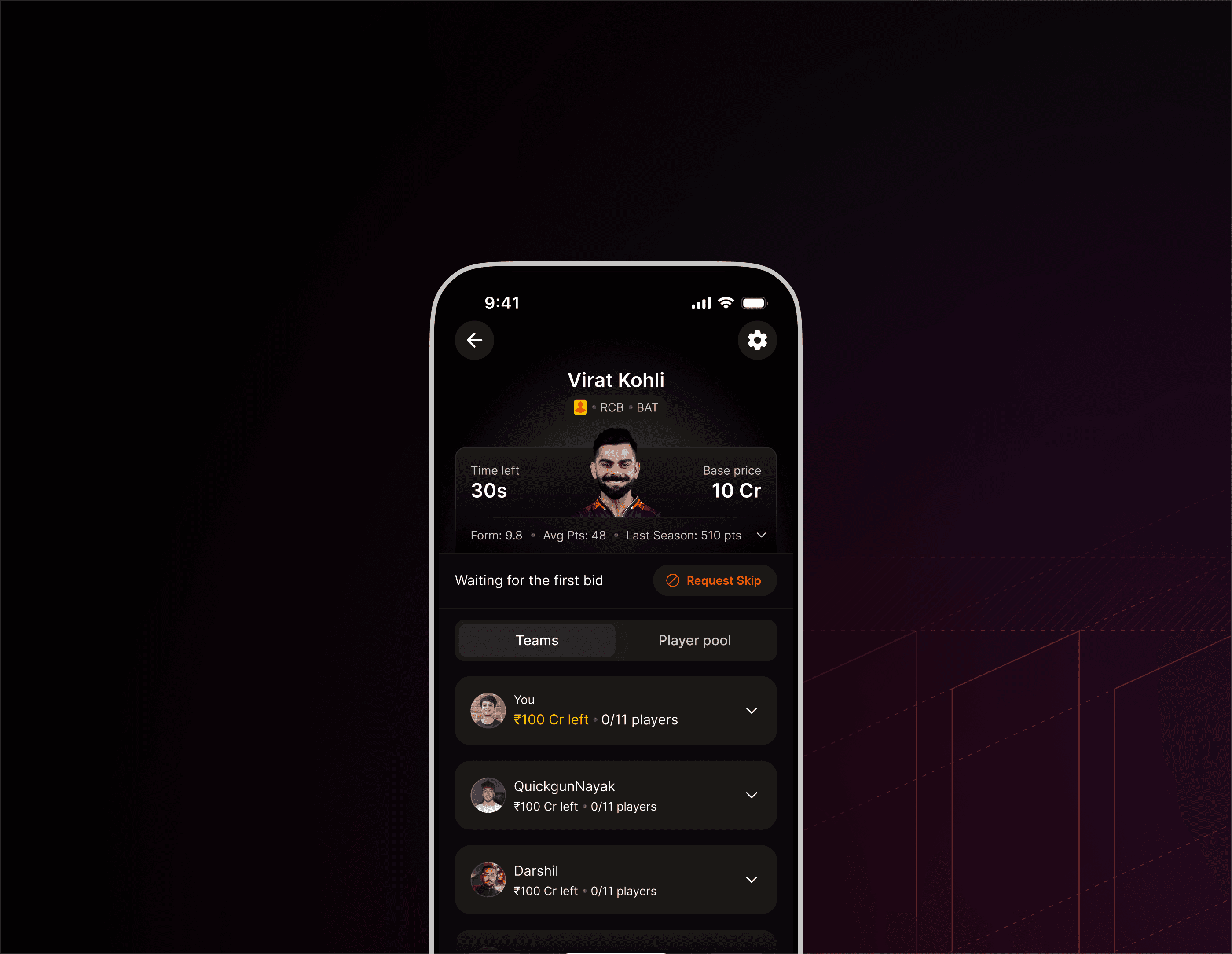
Users signed up excited, then stopped showing up within days. Manager Mode runs across a full tournament. Weeks of matches, not a single evening. Phase 1 was built like an extension of Dream11's match-by-match fantasy, but a multi-week commitment needs a completely different engagement loop. There was nothing pulling users back between matches.
By the time I joined the squad, transfers had already been removed in an earlier version. That was the one feature that gave people a reason to open the app daily: swapping players based on recent form. Without it, Manager Mode felt static. You picked your team on day one and then just... watched.
2. The UX was fighting the format:
Snake drafts, auctions, multi-match team management, tournament-length scoring. It's a lot. Dream11's core fantasy experience is simple: pick 11 players, set a captain, join a contest. Manager Mode asks you to think in terms of budget allocation, draft order strategy, transfer windows, and league standings that change over weeks.
Cramming all of that into a mobile app without overwhelming people needed more than small tweaks. Entry points were hard to find. The home screen didn't tell you what was happening in your tournament. And the boundary between Manager Mode and Dream11's core product was blurry.
II. What the Research Revealed
1. Qual + Quant + Concept Testing:
We ran three research tracks at the same time. I worked closely with our design researcher on all of them. Qualitative interviews with active and churned users surfaced what people actually felt about the product. A quantitative survey (which I helped write) measured how widespread each pain point was. And concept tests let us validate new ideas before committing engineering time.
I led persona mapping to segment players by what motivated them, how skilled they were, and how they engaged with the product over time.
We ran a likes/dislikes study on Phase 1 to figure out what to keep and what to scrap.
Retention and attrition analysis showed us exactly where in the tournament lifecycle people were dropping off.
CS calling summaries confirmed demand: users were asking for Manager Mode for full tournaments inside the Dream11 app.
2. Four findings that changed the direction:
Transfers were the core loop, and we'd killed them. They weren't a nice-to-have. They were the reason people came back. Swapping players based on form made users feel like they were actually managing a team. Without transfers, the product was just a one-time bet.
Auction mode created the strongest emotional attachment. Users who drafted through auctions felt real ownership of their squads. The pressure of bidding against others, working within a budget, the social tension of it. People remembered their auction experience weeks later.
Most users didn't even know Manager Mode existed. The entry points were unclear. Even power users of Dream11's core fantasy had never seen it. Low access correlated directly with low engagement.
Pricing felt wrong to users. They expected the paid version to work like Mega contests: similar entry fees, similar reward structures, with extra incentives for the longer time commitment. The mismatch was creating friction before anyone even played.
III. How Research Shaped the Redesign
1. Bringing back the daily reason to return:
The research left no ambiguity about what mattered most: interactivity. I rebuilt the design around transfers and boosters, giving users real mid-tournament decisions that connected to what was happening in actual cricket. The whole point was to honour what "managing" a team actually means to fans.
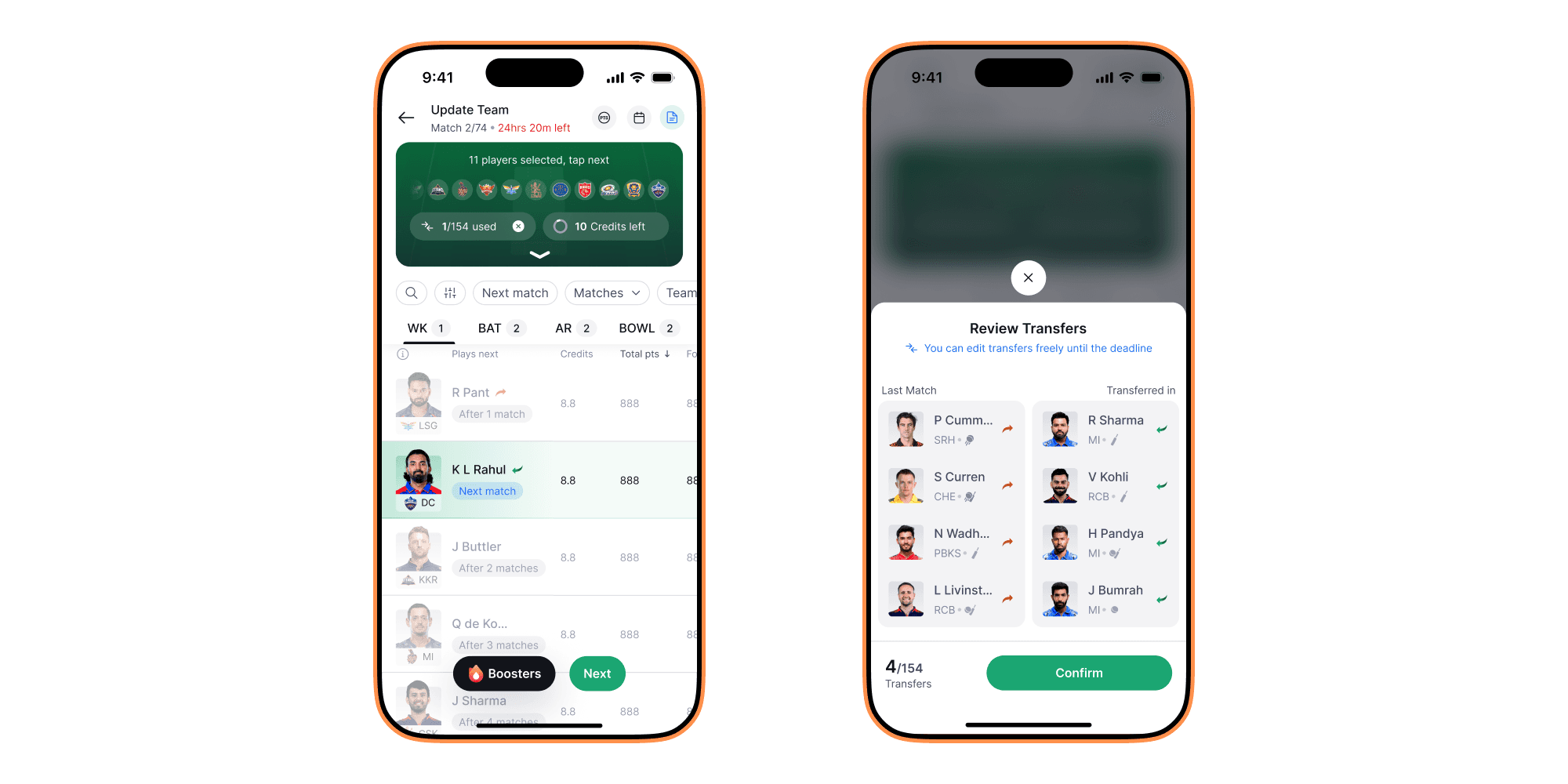
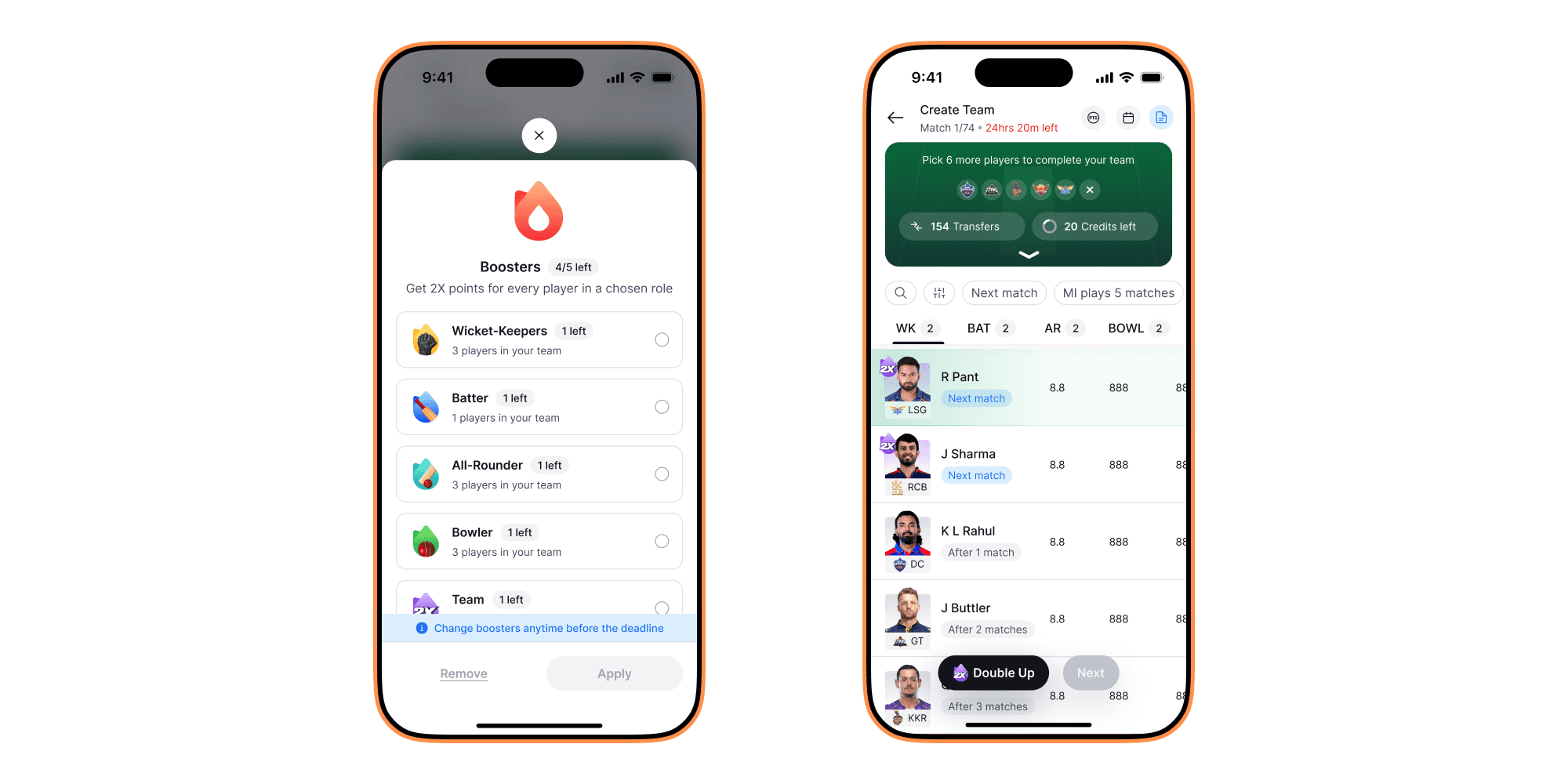
I designed a transfer bottom sheet that shows remaining transfers with clear allowance tracking, and a booster bottom sheet with per-booster usage (e.g., "4/5 Power Batter used"). When the transfer window closes between matches, the CTA greys out with a live countdown until it reopens. I also added booster and transfer info directly onto the leaderboard, so you can see how your competitors are playing strategically. And I introduced a team confidence score that tells you how your squad is trending relative to the rest of the field.
2. Staging complexity instead of hiding it:
The complexity is what makes Manager Mode different from regular fantasy. I didn't want to flatten it. The home screen alone needed to handle 7 components (header, how-to-play carousel, contest card, private contest entry, share module, banner module, bottom nav) across multiple tournament lifecycle states. I designed each state with specific data points and CTAs that shift as you progress from first visit to joined to mid-season to tournament end.
Created a 4-card auto-scrolling how-to-play carousel that shows up before you join and then tucks behind a help icon after. No modal tutorials.
6+ distinct home screen states: pre-join, post-join (first match hasn't started yet), active tournament, transfer window closed (greyed CTA with countdown), weekly leaderboard transition, and tournament complete. Each one surfaces different data: cumulative points, weekly points, captain/VC cards, transfers and boosters remaining.
A 4-tab bottom nav (Exit to Dream11, Home, Schedule, Tour Stats) gives Manager Mode its own space inside the app while keeping a one-tap route back to core fantasy.
Multi-tournament and multi-sport support so users can browse and switch between live, upcoming, and finished tours.
3. Making Manager Mode findable:
I tackled access at several levels. The games entry point needed large and small banner variants, and I went through many iterations to get the balance right with the existing fantasy UI. I designed a transition state for first-time visitors entering Manager Mode from Dream11, with the number of impressions configurable via Firebase. That turned what was basically a navigation gap into a proper onboarding moment.
I also owned the full private contests flow: creating a contest, naming it, sharing it, joining via invite link. The edge cases were tricky (what happens if someone tries to join during a transfer window lock? what if the contest is full?). But the private contest system ended up being an important social hook. Friends could join mid-tournament and get the same number of transfers and boosters as everyone else, so late joiners weren't penalized.
For IPL specifically, I created custom banners and assets using a display typeface called Trim that I licensed for cross-platform use. It gave Manager Mode a visual identity distinct from standard Dream11 surfaces.
4. Working across the team:
This was a true cross-functional effort. I worked closely with the Director of Product on strategy and prioritisation. During build phases, I sat in daily war rooms with engineering, catching edge cases and sorting out copy and layout issues on the spot. I also worked with the data team to define MGMR data points across every flow and screen.
When the product moved to an outsourced development model (an external agency building a standalone ReactNative app), I made sure the design stayed consistent between the app-in-app experience inside Dream11 and the independent download.
Helped shape the quant survey questions and refine calling scripts to reduce bias in user interviews.
Kept Figma files current with all states, copy, and responsive variants. I flagged missing states before engineers ran into them, not after.
Built Cursor rules (.mdc files) defining the Manager Mode Design Language: design tokens, typography, and component guidelines. The engineering team could scaffold components directly from Figma with roughly 60-70% accuracy, which cut a lot of back-and-forth.
III. Results
1. Scale and retention:
8.5M+ users engaged in seasonal gameplay during IPL. 3.5M+ stuck around for the full two-month tournament. That retention number is the one I care about most. It validates the core thesis: if you give people real reasons to come back (transfers, leaderboard movement, weekly rewards), they will. At peak, we had 150K users playing at the same time.
5.5M+ users actively participated in Manager Mode overall. The product put Dream11 in a category of one in India: the only large-scale fantasy platform with a season-long format. Every competitor was still doing match-by-match.
2. What shipped:
I designed the full MGMR relaunch: a ground-up redesign built on 18+ months of research and iteration. The product also shifted to free-to-play, opening it up to all Dream11 users instead of gating it behind entry fees. Every major research finding got addressed: interactivity restored, complexity staged properly, access fixed, and a social layer added through private contests.
Home screen with 7 core components across 6+ lifecycle states, from first-time onboarding through tournament completion.
Snake draft, auction mode, and best ball, each with their own flows and edge-case handling.
Complete private contest system with error states for timing conflicts, capacity limits, and cross-version compatibility.
Multi-tournament and multi-sport architecture for simultaneous participation across tours.
A design system with Figma MCP + Cursor integration for scalable design-to-code handoff.
3. What I took from this:
Two things stood out. First, the tension between ambition and honesty. A season-long fantasy format is genuinely new for India's market. But Phase 1 had real problems, and being upfront about that with the team was important. Second, the tension between user needs and business constraints. Transfers had been removed because they were operationally expensive. Arguing to bring them back required data, not just design intuition.
The structured research approach we built (qual, quant, concept testing, persona work, retention analysis) ended up becoming a model other squads referenced. It gave the team a shared vocabulary for design decisions and made it possible to challenge assumptions with evidence.
year
2024–2025
timeframe
Multi-phase product cycle
tools
Figma
category
Product Design · Interaction Systems
View
01
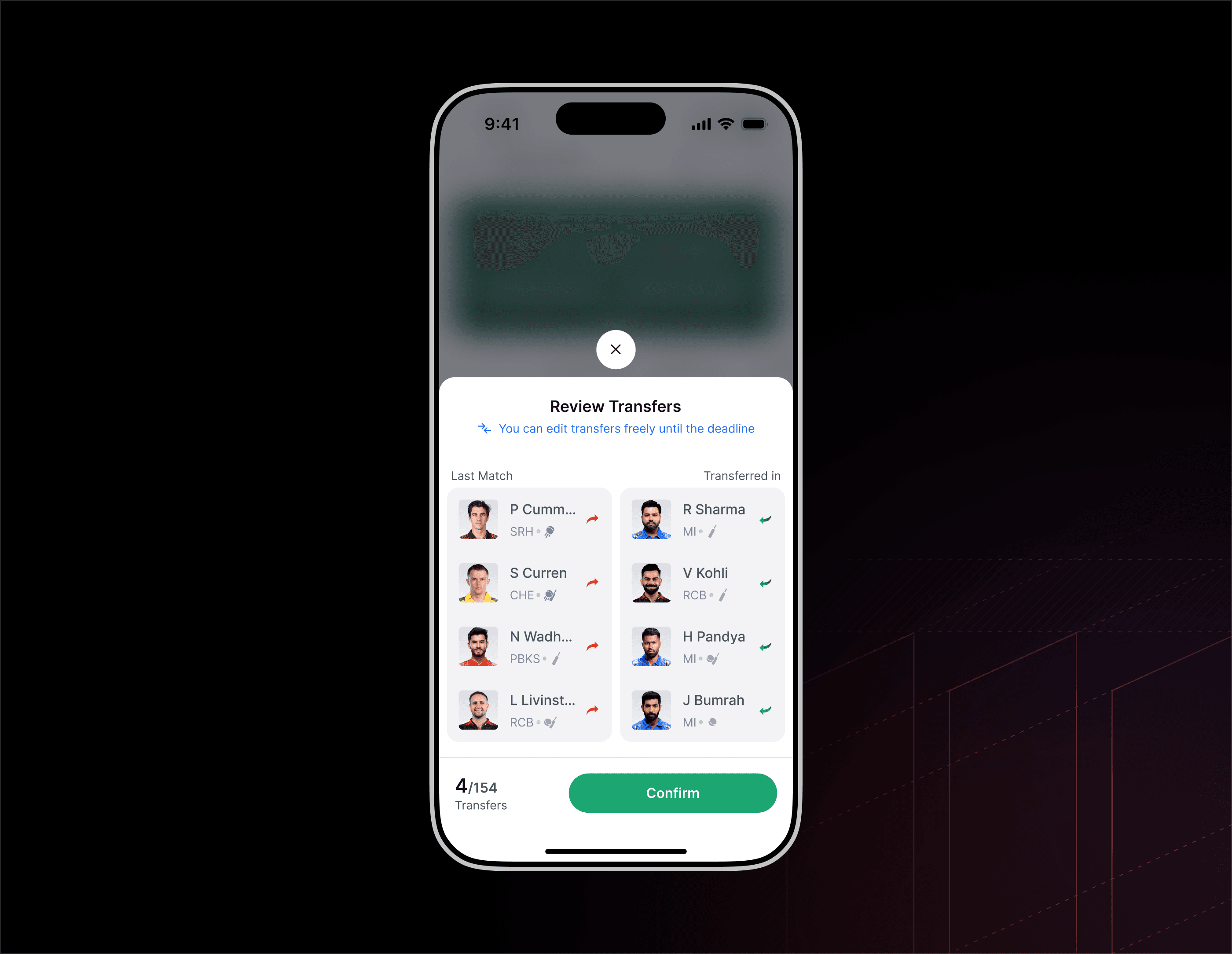
A quick summery of all your changes for that match
02
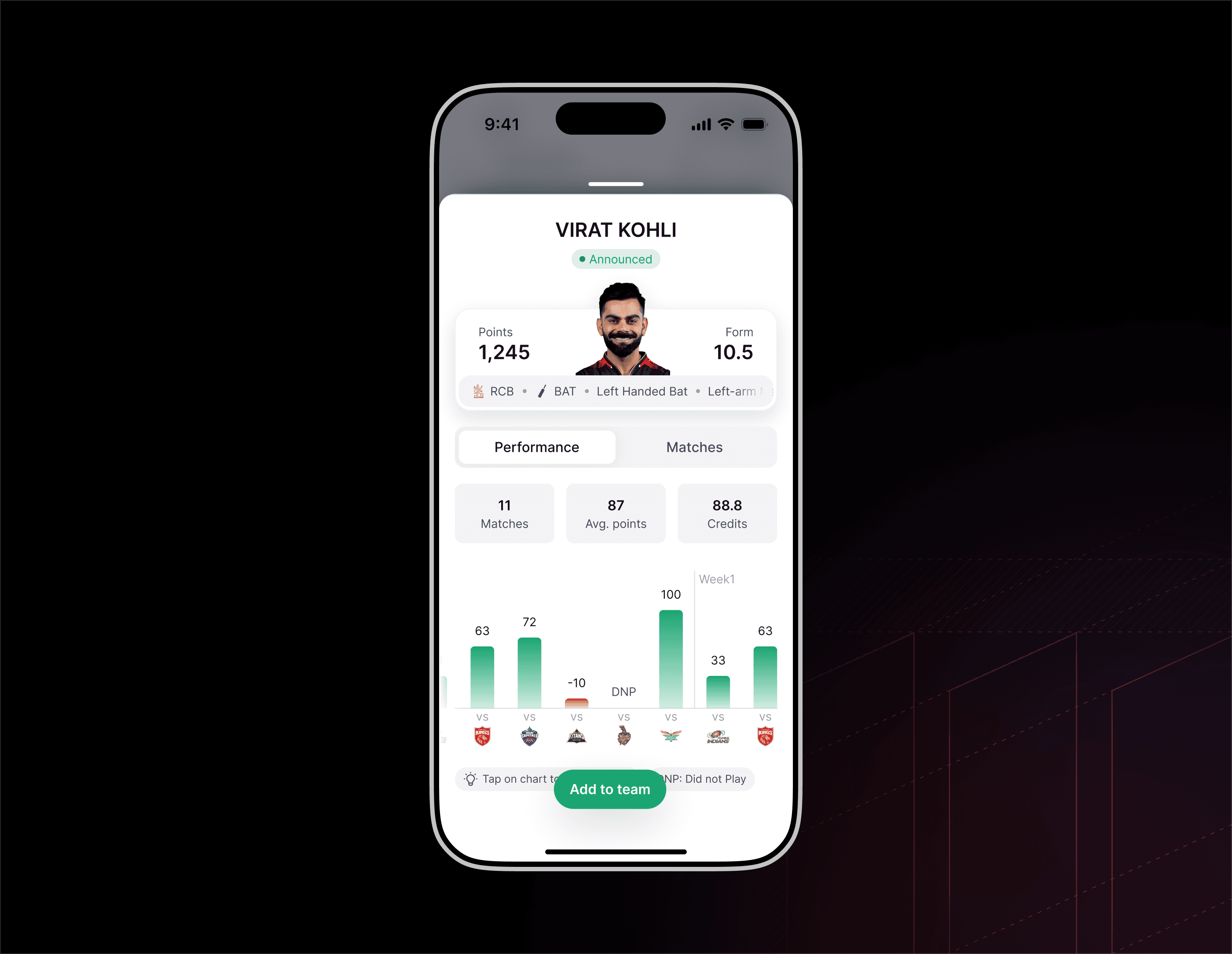
Deep dive into player's stats
03
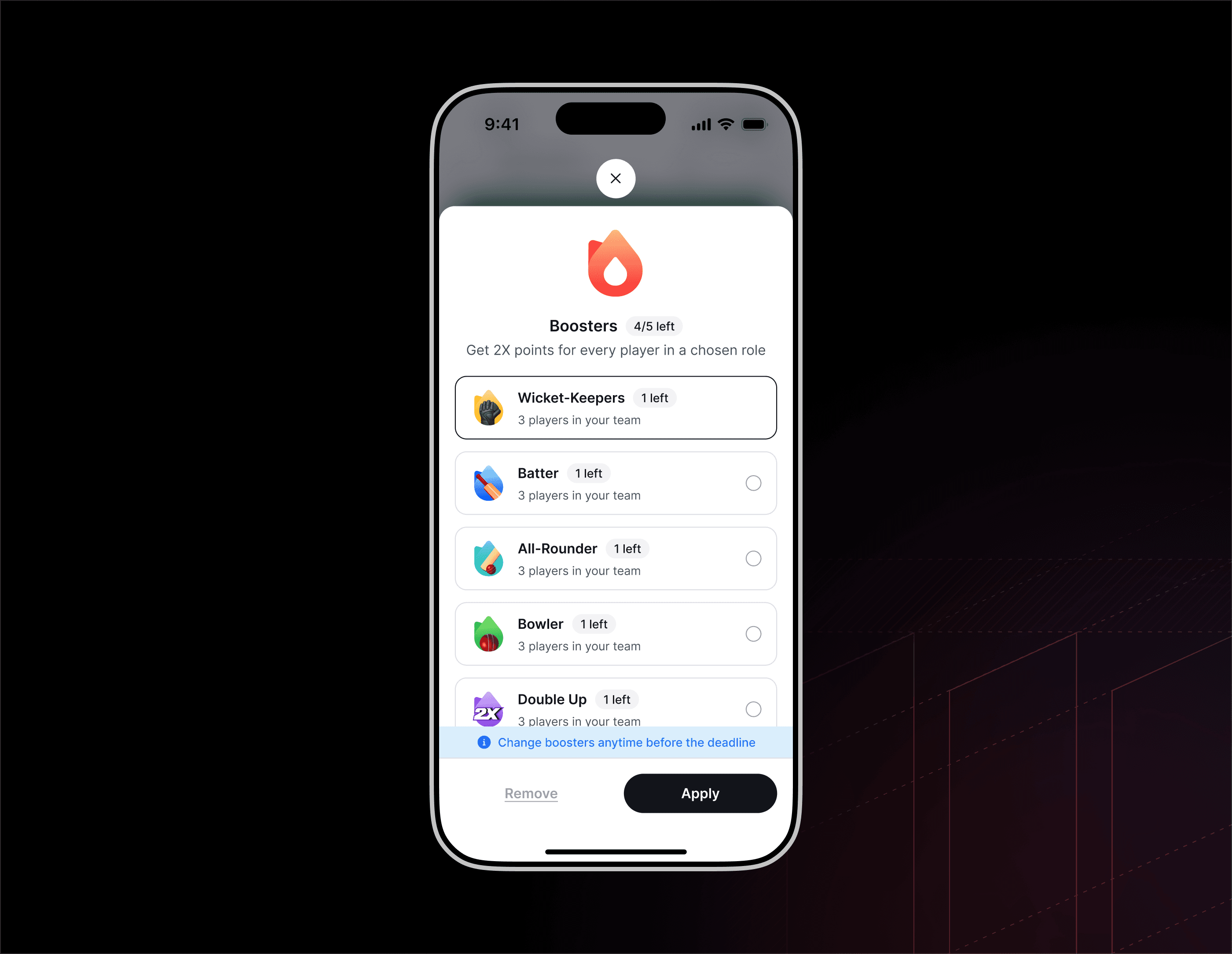
Strategically apply boosters to multiply your points and get advantage over others