
ROLE IN PROJECT:
Product Designer II · Dream11
PROJECT YEAR:
2022
DURATION:
4 months
WORK DONE:
Bringing a Telegram economy inside Dream11
Dream11 spent years trying to build a social layer into the app. Feeds, mostly. None of it took. What we eventually worked out was that our users were already being social, just somewhere else, and in a shape nobody had thought to design for.
01. THE SOCIAL LAYER WE KEPT BUILDING WRONG
We'd tried feeds. We'd tried most of the things you try when you want two hundred million people to behave like a community. Not much of it worked, because our users weren't opening the app to talk to each other.
They were being social, though. Just not with us.
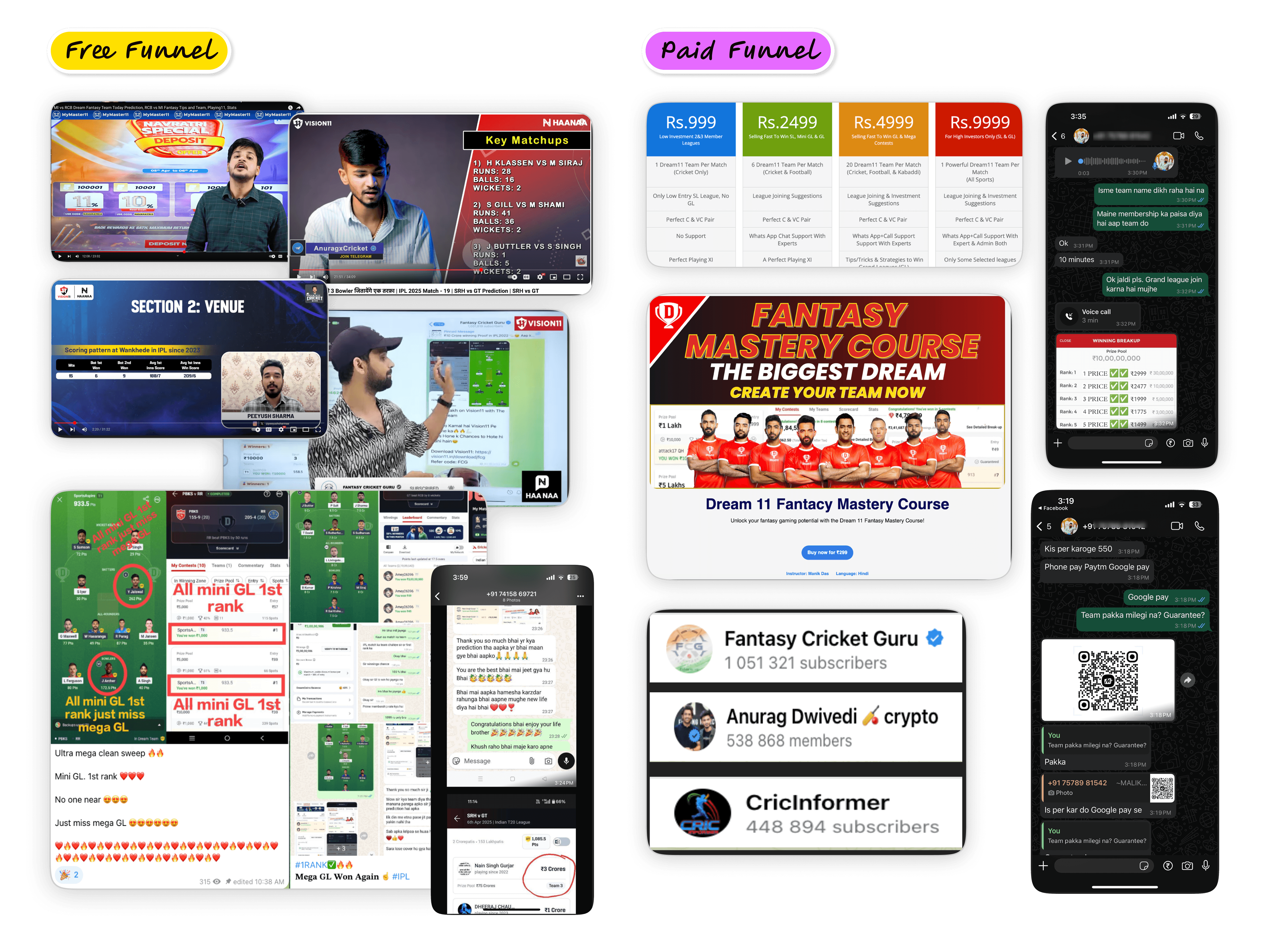
Fifteen minutes after lineups drop, with money on the match, a lot of them were going to Telegram and WhatsApp and paying someone they'd never met for a ready-made team. Free groups feeding paid ones. Screenshots of winnings as the sales pitch. Then back into Dream11 to actually play.
None of this was a secret. Everyone in the building knew. The question was never really whether to do something about it, it was when.
02. IT WASN'T AN INFORMATION PROBLEM
The obvious explanation is that people went outside because we weren't giving them enough. We had a research section full of stats and most of these users had already been through it, so that doesn't hold up.
The problem sat one step later. Picking eleven players out of twenty-two, against a deadline, with real money on it, is a decision people freeze on. More data doesn't unfreeze them and can make it worse. What they wanted wasn't information so much as permission to commit.
So they paid someone else to make the call.
Sixty-eight percent of players were making exactly one team. On a platform where making more teams is how you end up joining more contests, that's a user problem and a business problem at the same time.
A lot of what they were buying was fake, too. Winning screenshots are easy to fabricate. People bought anyway, because at 7:15 with the deadline coming you will trust more or less anyone who says they have a team that wins.
03. THE BET
Bring the whole thing inside, where it could be accountable. Do the free version first.
Gurus post teams, users clone them, no money changes hands.
The order mattered more than it sounds. The experts outside the app had spent months or years building a following. Ours were regular players we'd picked out and put on a stage, and nobody had any idea yet whether they were any good. Charging from day one would have meant asking someone to pay a stranger for something they'd never tried. Free first gave the Gurus a chance to earn a name before anyone had to put money on it.
04. FIVE DECISIONS
WHAT YOU SEE FIRST
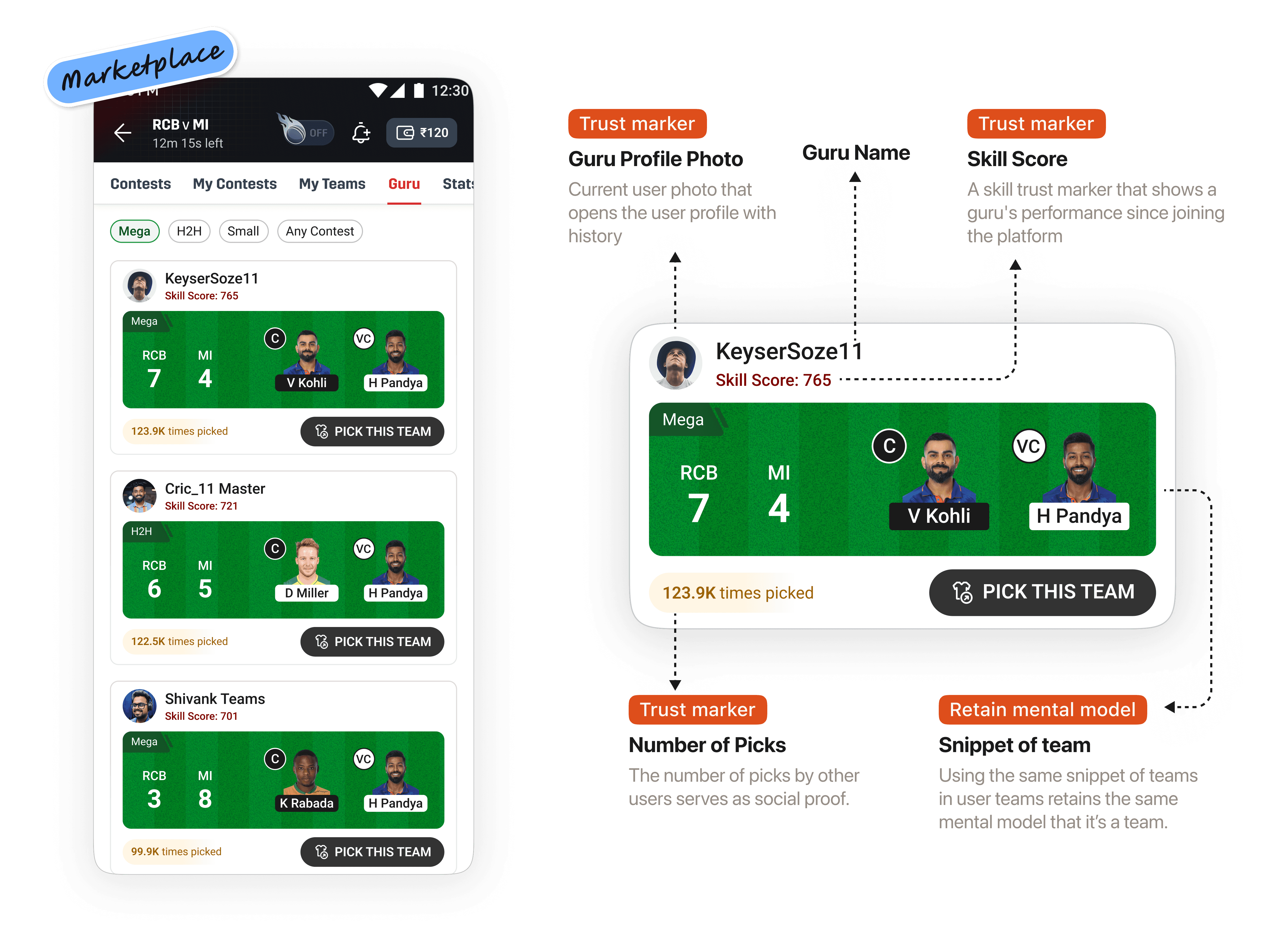
The card gets about fifteen seconds to answer the question the black market was answering with fake screenshots. Why should I trust this?
It's three bands, and the order is the argument.
At the top, who they are: photo, username, skill score. It's the smallest band on the card.
In the middle, the team, taking most of the space. The pitch, the split across both sides, and the captain and vice-captain with faces and names.
At the bottom, how many people have picked it, and the button.
Identity gets the top position and the team gets the area. You need to know whose team it is, but you aren't really judging the person, you're judging eleven players. The name works as a label on the thing you're actually assessing.
Putting captain and vice-captain on the card is the decision I'd defend hardest. Captain scores double and vice-captain one and a half, which makes it the smallest choice in fantasy cricket and the one that decides most matches. If you can see a Guru's C and VC without opening anything, you can weigh their judgment on the highest-leverage call they made. The rest of the team you read as a shape. Seven from one side and four from the other tells you they've leaned somewhere before you've read a single name.
Skill score sits at the top and pick count at the bottom, both in the same colour, with the team between them. Top to bottom it comes out as who they are, what they built, and how many people had already backed it.
A TRUST MARKETPLACE WITH NO TRUST YET
The hard part of launching something like this is that its whole value is social proof, and on day one there isn't any. A card saying nobody has picked this team and it has won nothing doesn't just fail to build confidence, it actively removes it.
I wanted the historical numbers tracked from the first round even though there was no way to show them yet. Engineering's answer was a feature flag. Build the counters, keep them dark, switch them on once the data was worth looking at.
What we showed instead was a live count of how many people had cloned that team for that round. Because it resets every match, a Guru who joined last week isn't buried under someone else's back catalogue, and a good week counts for more than an old one.
One rule made the number mean something. Only clones through the marketplace count. Teams a Guru shares into their own WhatsApp group don't. The black market's proof could be manufactured, and ours couldn't.
A CLONE THAT KEEPS UPDATING
The easy version of this is a download button. Take the team, it's yours, done.
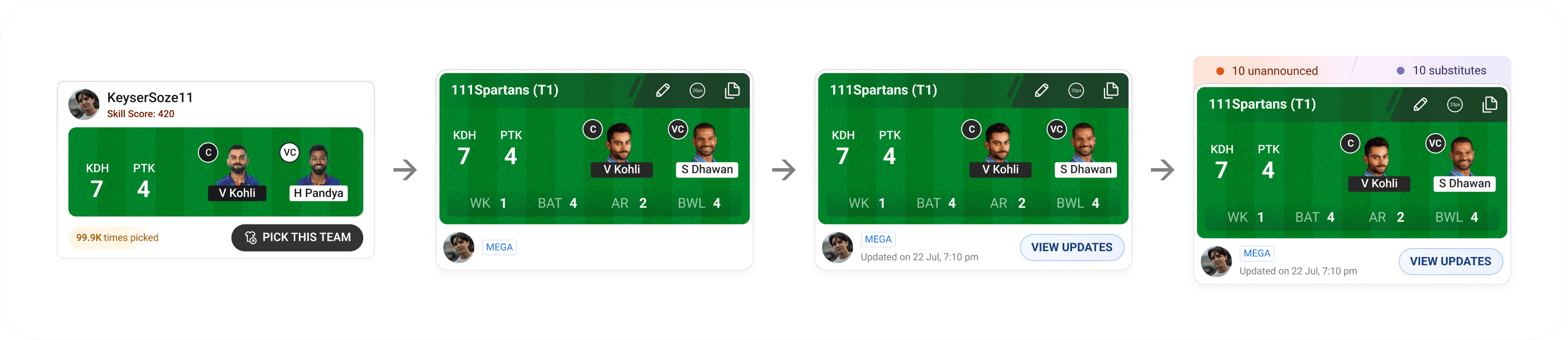
We built the harder one. A Guru can carry on editing a posted team right up to five minutes before lock, and when they publish a change, everyone who cloned it gets a notification and a View updates prompt sitting on their team.
So you're not really taking a team. You're following someone who is still working on it while you sleep on it.
That decision accounts for most of the card's complexity. There are four states and they exist to carry it: Pick this team, Picked, View updated team, and View team for a Guru looking at their own. Each one describes where you stand in a relationship rather than what a button does.
RULES THAT MADE THE SUPPLY WORTH BROWSING
An open marketplace fills up with noise. Three constraints kept it readable.
Three teams per Guru per round, maximum. No two teams tagged to the same contest type and risk profile, so you can't post three versions of Mega and Balanced hoping one of them lands. Gurus locked to the sports they'd been selected for.
The effect is that a Guru has to decide what they actually think instead of covering the spread. It's the difference between advice and a lottery ticket.
GOING TO WHERE PEOPLE FROZE
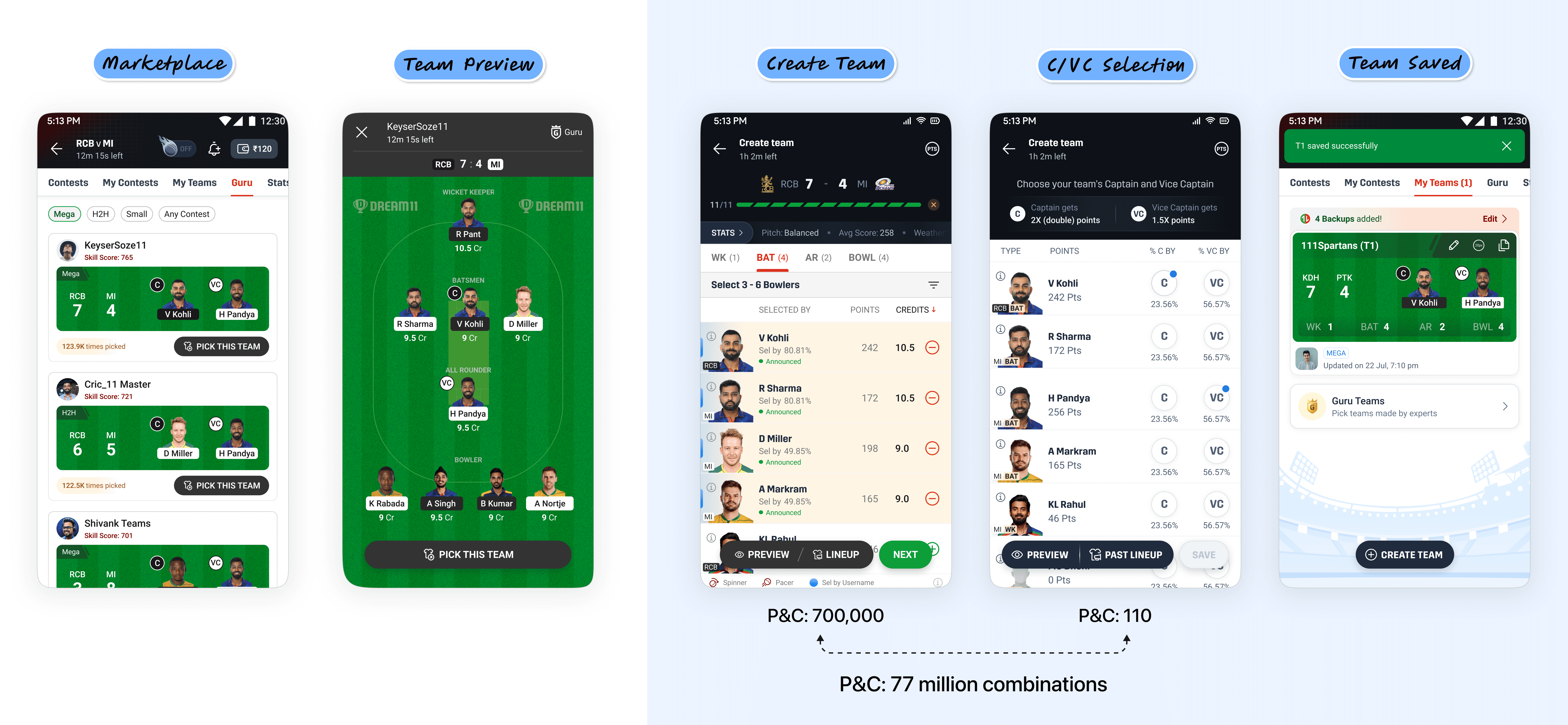
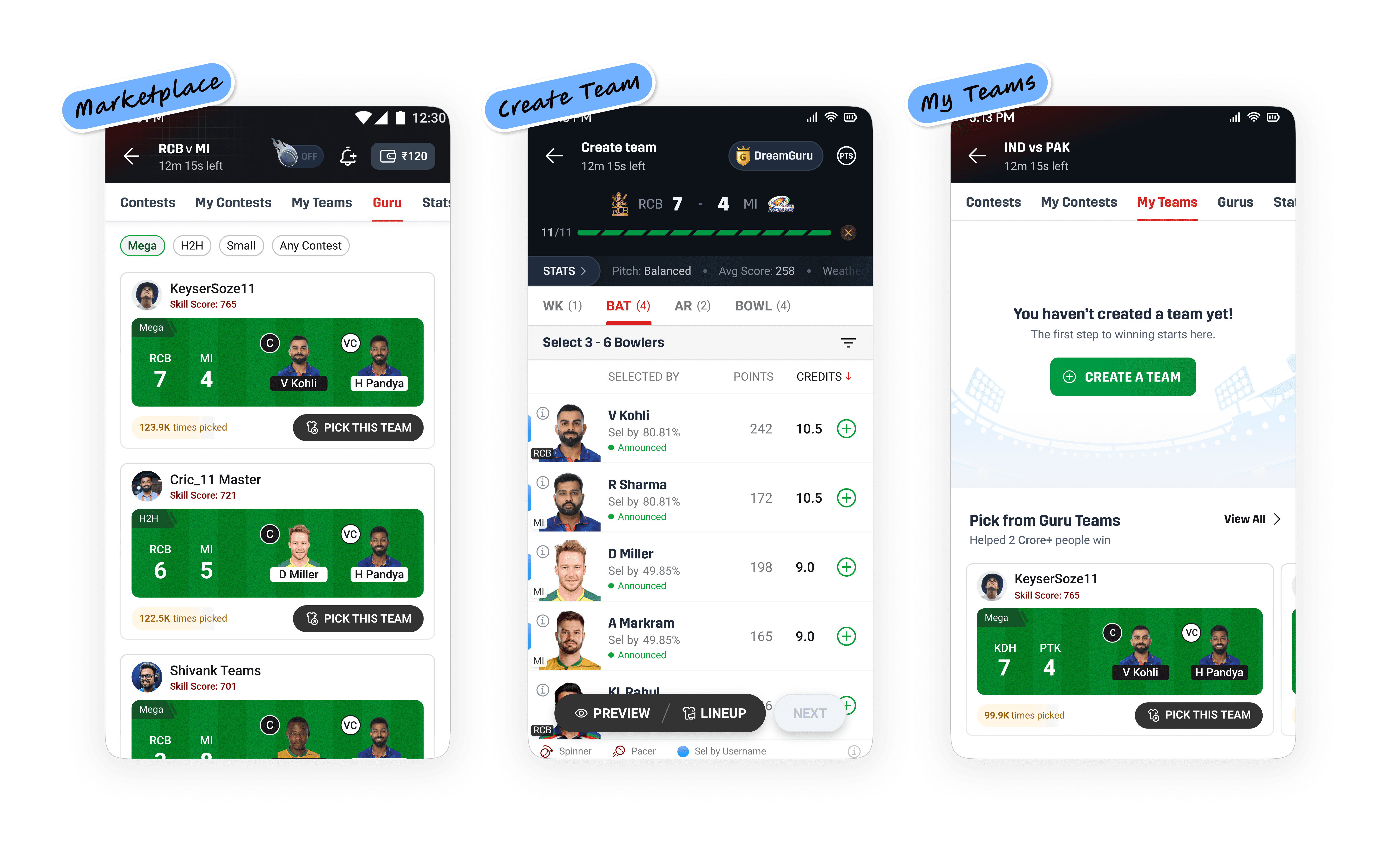
A marketplace you have to navigate to is a room nobody visits. The freeze doesn't happen in a marketplace. It happens on the create team screen, on an empty My Teams page, on a match card twenty minutes out.
So Guru teams turned up in all five places. Match Center, Contest Home, My Contests, My Teams, and inside Create Team itself.
Each entry point shipped as its own A/B test against the same metric, because we wanted to know which moments of hesitation were real rather than assume we already knew.
05. WHAT IT MOVED
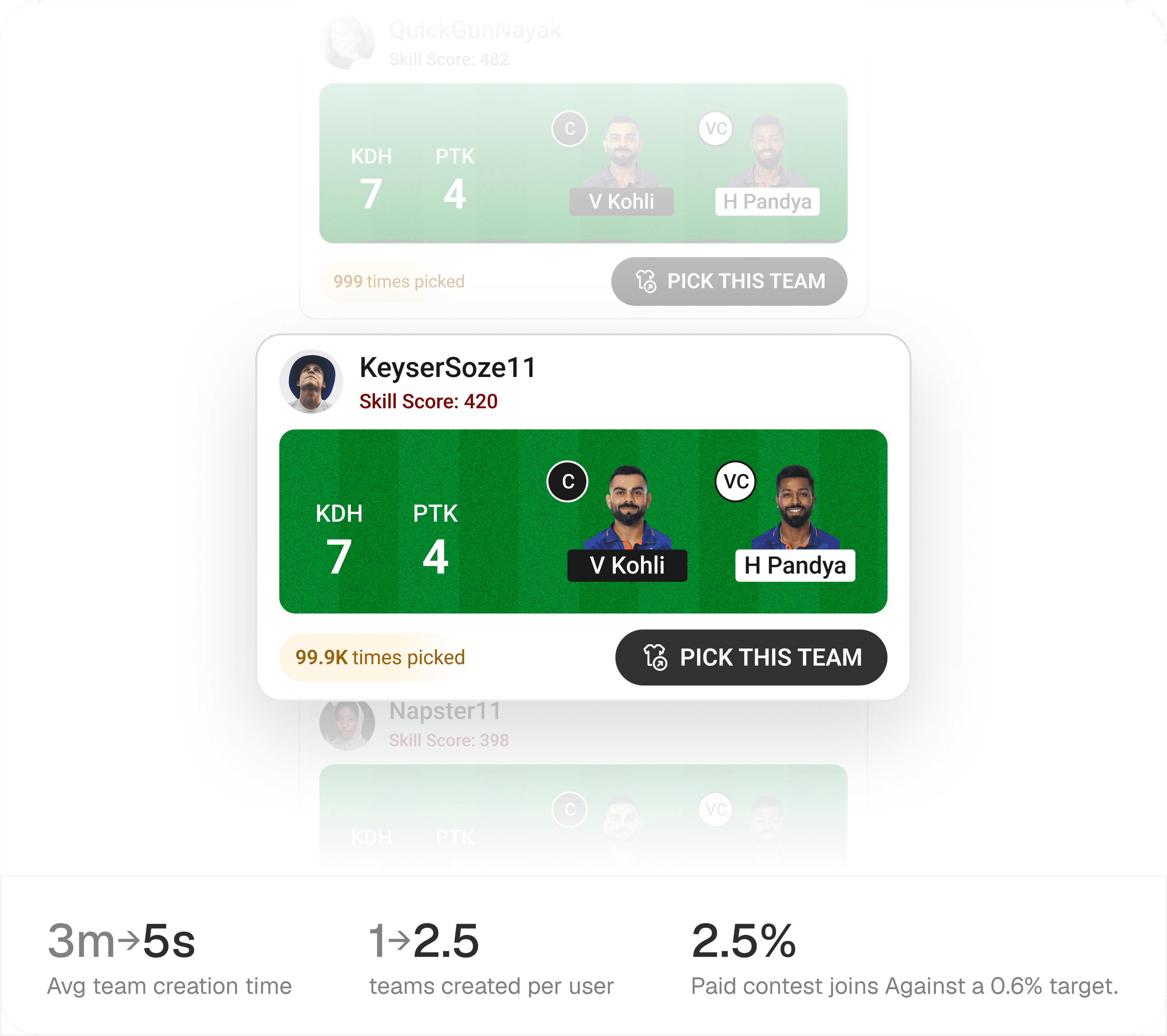
3m → 5s
Average time to a team The wall cleared, the captain call left where it was.
1 → 2.5
Teams per user Most players had been stopping at one, so the movement came from the people who'd been losing, or quietly paying someone off-platform.
2.5%
Lift in paid contest joins Against the 0.6% we'd set as the bar.
The free version also did what a first version is for. It proved the model well enough that Dream11 committed to building the paid marketplace.
06. WHAT I'D DO DIFFERENTLY
We shipped a trust marketplace with no ranking in it at all.
Teams appeared in the order they'd been posted. Not by skill, not by recent form, not by how often they'd been picked, just by who got there first. We knew it was wrong at the time. The sort criteria we wanted were written into the same document, filed under future phases.
The reasoning was that we had no data to rank on yet, which is backwards. Ranking is how you generate the data. It decides who gets seen, that decides who gets picked, and that becomes the record you'd rank on later. We spent a season teaching the marketplace that being early counted for more than being good, then had to unpick it.
The other one is that we believed the launch numbers. Week one looked extraordinary. It was the notifications. Three weeks later it settled to the real figure, which was the number we should have been reading from the start.
07. WHAT HAPPENED NEXT
Phase 1 was the free version, built to prove the model. The paid marketplace that came after it, with pricing, creator earnings and the content layer.