
ROLE IN PROJECT:
Sr. Product Designer
PROJECT YEAR:
2025
DURATION:
3 Weeks
WORK DONE:
I replaced a two-minute flow with a bidding war
Overview
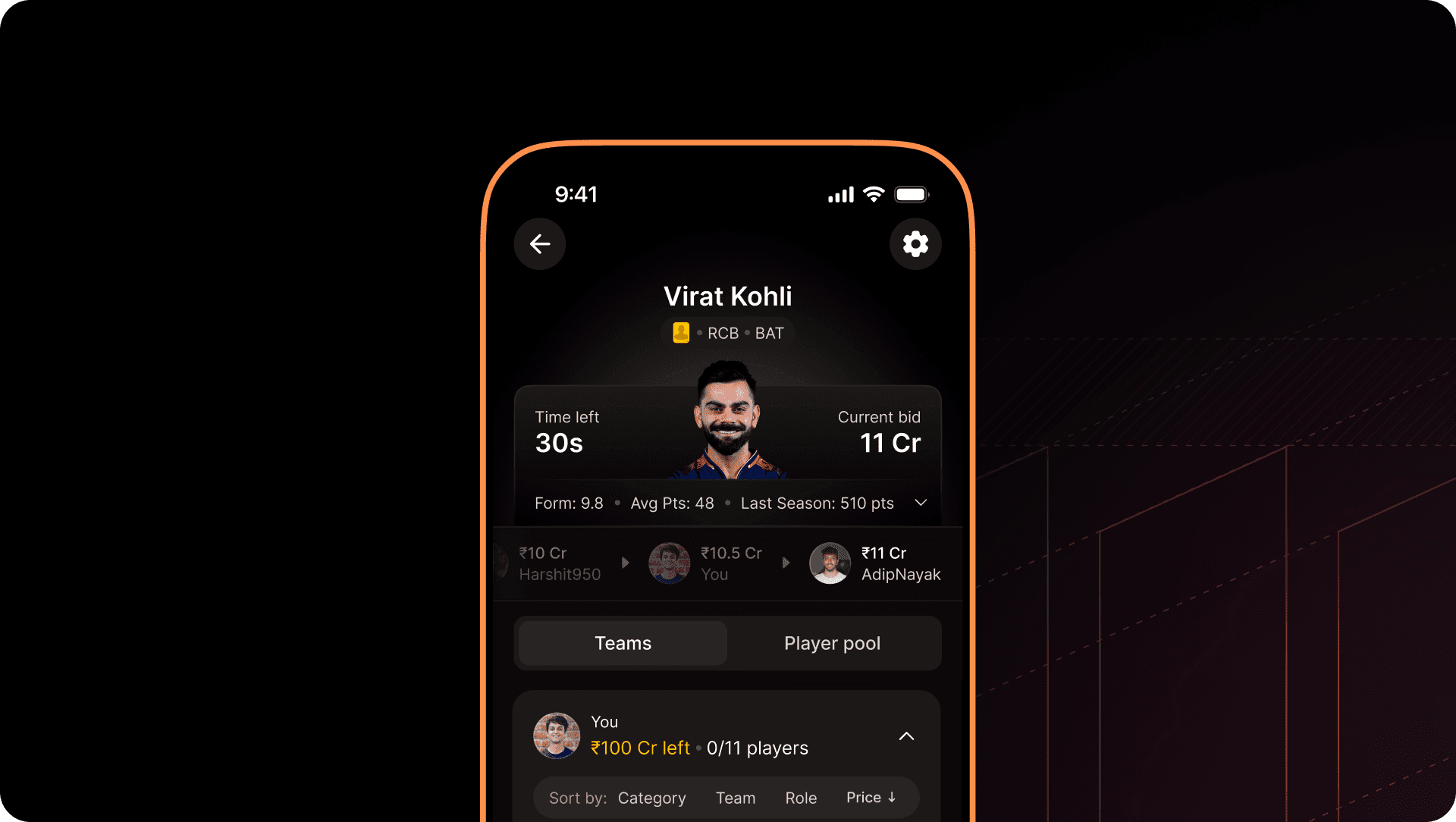
What if building your fantasy team felt like being at the IPL auction table? LIVE Auction replaced Dream11's static team-picking flow with a real-time, social bidding experience. A 2-minute solo task became a competitive game between friends.
The Problem Space
A 200M-user product with a participation ceiling: Dream11 had a team-creation problem. The core fantasy flow (pick 11 players from a credit-based pool, set captain and vice-captain, join a contest) was efficient but emotionally flat. Users treated it like filling out a form. Session times were short, repeat engagement ran on money-motivation alone, and a massive segment of fans who loved watching IPL auctions on TV never brought that energy into the app.
The IPL mega auction is the most-watched non-match cricket event in India. Millions of fans sit through hours of bidding wars, arguing about strategy, budget calls, and squad balance. Dream11's team-creation flow had none of that.
The core tension: Fantasy sports users want to feel like team owners, not form-fillers. The credit-based system gave a thin sense of budget management, but it had no competition, no time pressure, no social stakes. Those are the things that make real auctions compelling.
The existing flow took about 2 minutes. Solo. No social layer. Purely transactional.
Real auction energy comes from bidding wars, bluffing, budget brinkmanship, and emotional ownership over every pick.
Dream11 had the user base and the sports context, but no mechanic that connected fandom to competitive team-building.
Research & Discovery 📑
User research signals: We ran user interviews that surfaced five findings. These shaped most of the design direction:
Ownership felt real. Auction-style team building made users feel like they earned their squad. Bidding on a player and winning him hit differently than just tapping a checkbox.
Power users were the most excited. The segment that already researches matchups, tracks player form, and studies pitch conditions saw auctions as a format that finally rewarded their knowledge.
The behavior already existed off-platform. Users were debating auction strategy in WhatsApp groups and Twitter threads during every IPL auction. We were formalizing something people were already doing.
Comprehension was a real risk. Casual users needed a lot of clarification. How do turns work? What's my budget? What if I don't bid? The concept was familiar from TV, but the mechanics were not.
Skill gaps hurt group play. In mixed-skill friend groups, less knowledgeable users felt intimidated. Even when interest was high, social dynamics became a barrier.
Scheduling constraint:
A synchronous auction needs everyone online at the same time. That's a hard coordination problem. This finding shaped the entire phasing strategy: start with private friend groups where coordination happens naturally (the same WhatsApp group handles it), then later build public matchmaking where the system takes care of scheduling.
Competitive landscape:
No major fantasy platform had done a live auction format. Draft-style modes existed in American fantasy football (ESPN, Yahoo), but real-time bidding with budget management and bid wars was untouched in the Indian market. A true 0→1 opportunity.
Framing the Design Challenge
Design principles:
Three principles governed the work:
Auction-first, not fantasy-first. The UI had to feel like a live bidding room, not a team management screen with a timer bolted on. Information hierarchy, pacing, visual drama: everything served the auction metaphor.
Progressive complexity. Immediately playable for casual users, but deep enough to reward strategy for power users. No front-loaded tutorials. Teach through the first few bids.
Social by default. Every screen state assumed other humans were present. Bid notifications, turn indicators, budget reveals, all of it created shared awareness without needing a separate chat layer.
The core UX loop:
Each auction round follows a tight four-step loop:
Player reveal. A player card enters the auction block with base price, stats, and role. This moment builds anticipation.
Bidding phase. Participants bid in real-time against a countdown. Bid increments, budget visibility, and competitor activity create tension.
Resolution. Winning bid locks. The player joins the winner's squad with a clear confirmation moment. Everyone else sees the result and recalculates.
Squad check. Between rounds, users review their evolving squad, remaining budget, and positional needs. This is where the strategy happens.
Phasing strategy:
Phase 1: Private social lobbies. Friends create a lobby, invite others, and auction players among themselves. Coordination is organic. This validated the core mechanic in a low-stakes, high-engagement setting.
Phase 2 (planned): Public matchmaking. The system would pair strangers into lobbies based on skill level and timing. This required solving the scheduling constraint at the platform level, with automated lobby creation tied to match deadlines